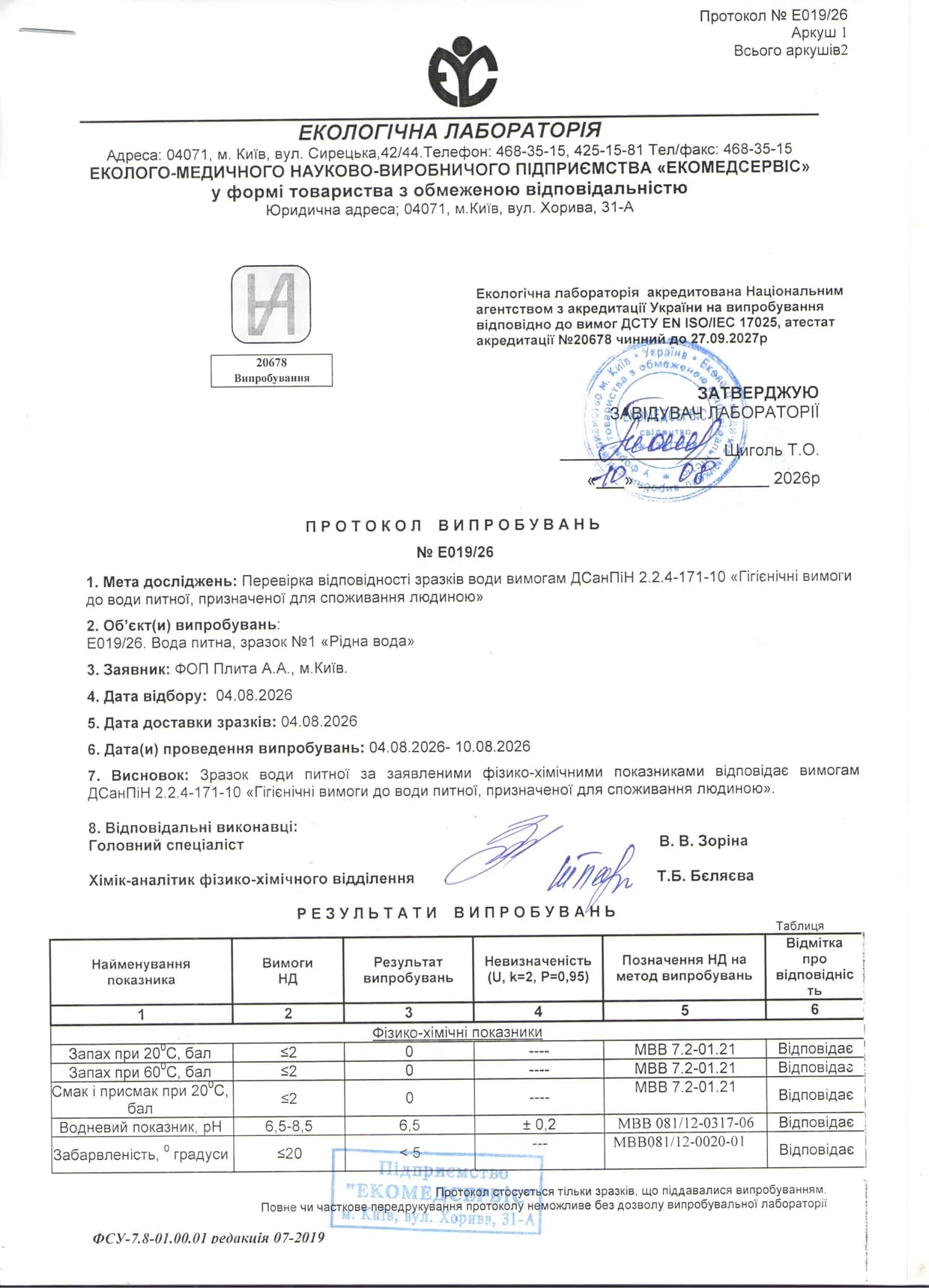
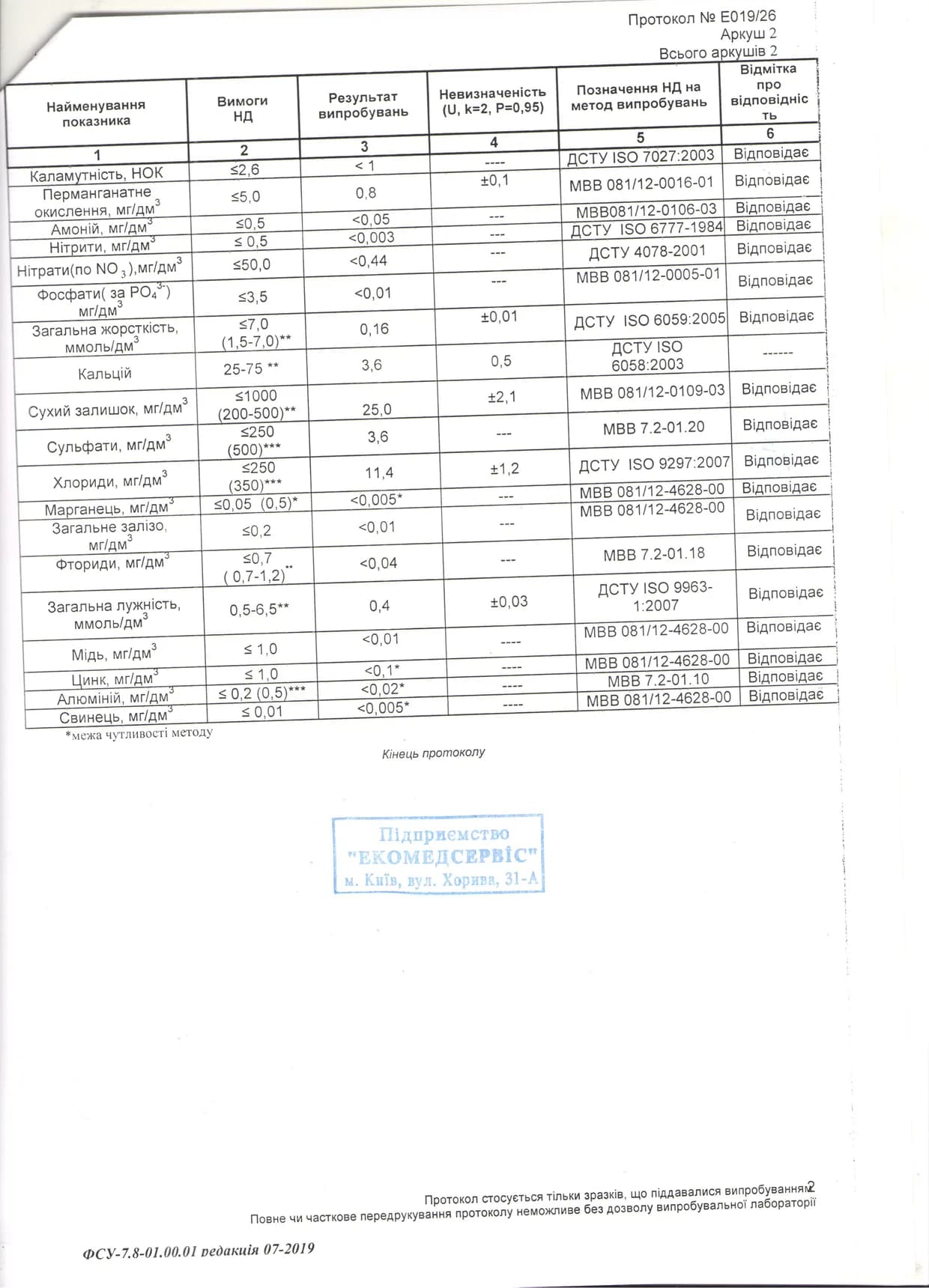
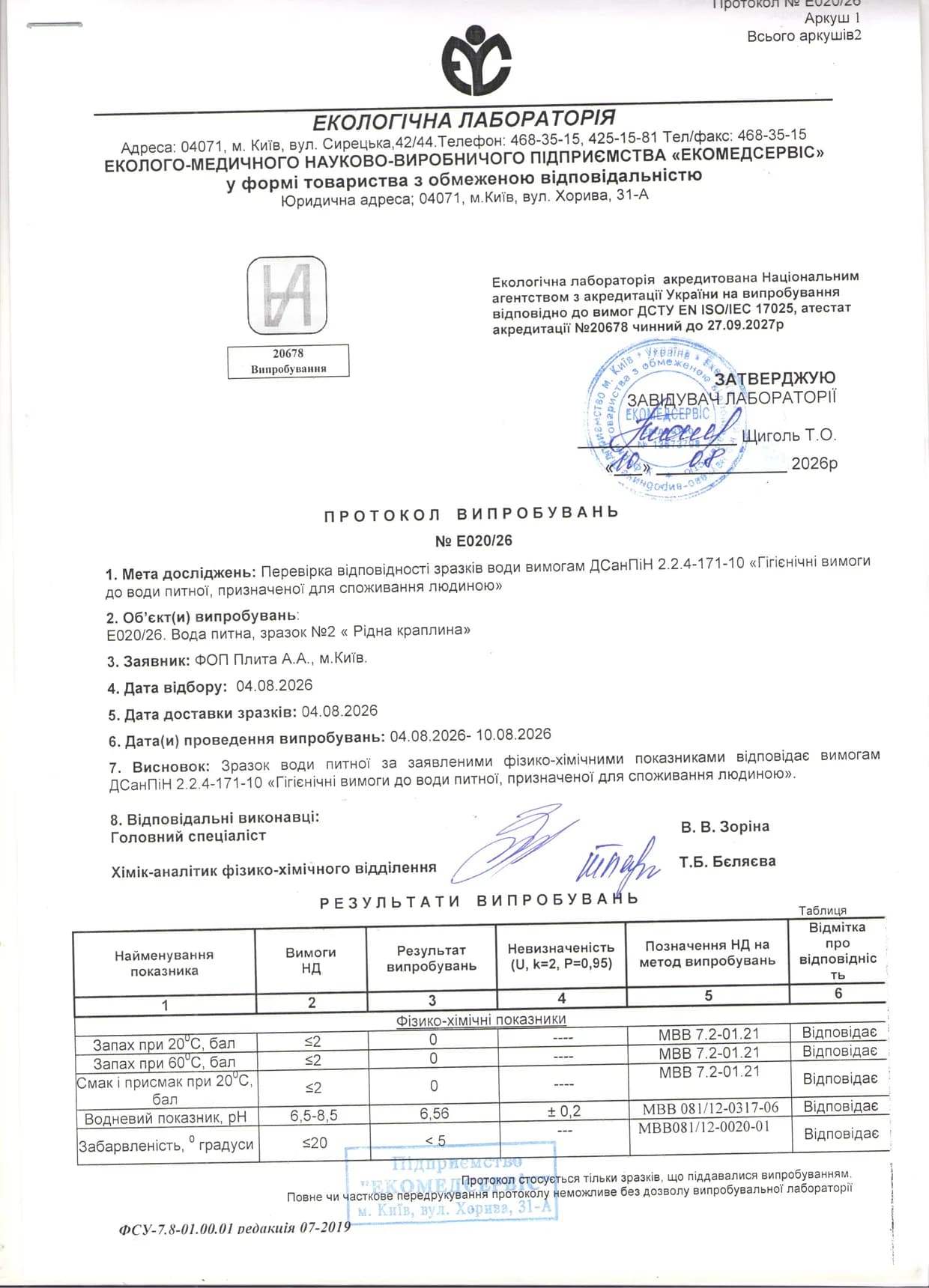
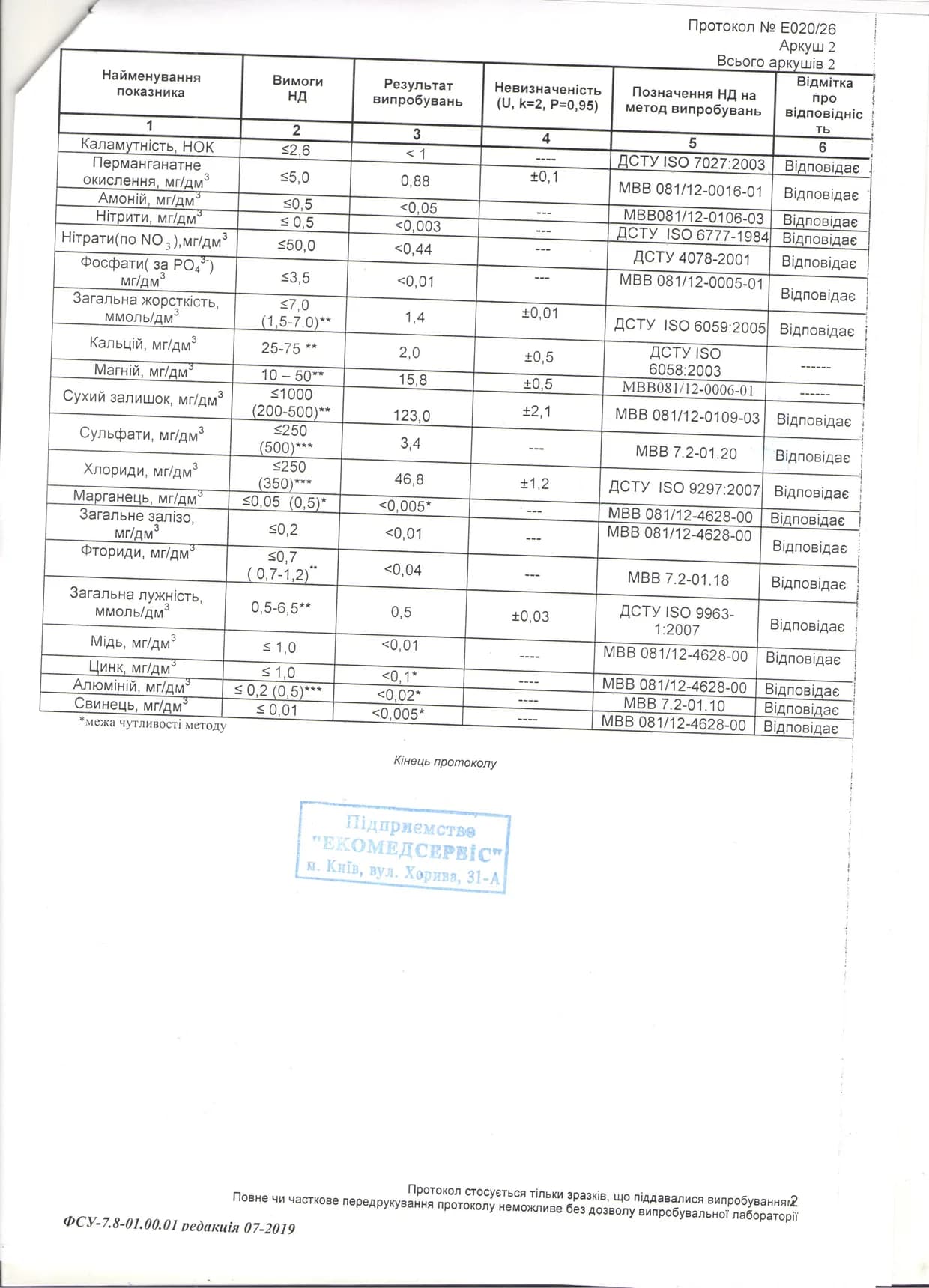
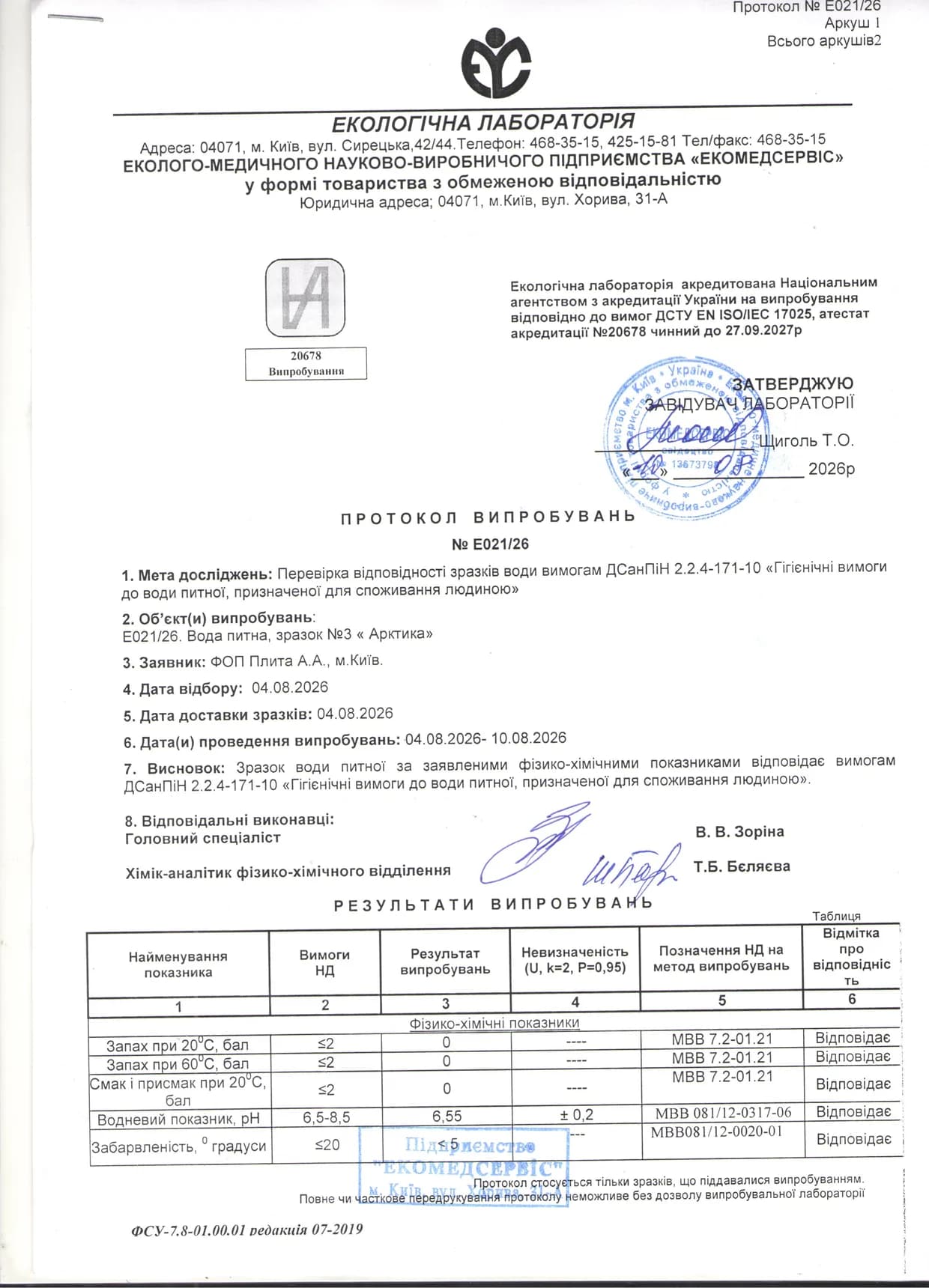
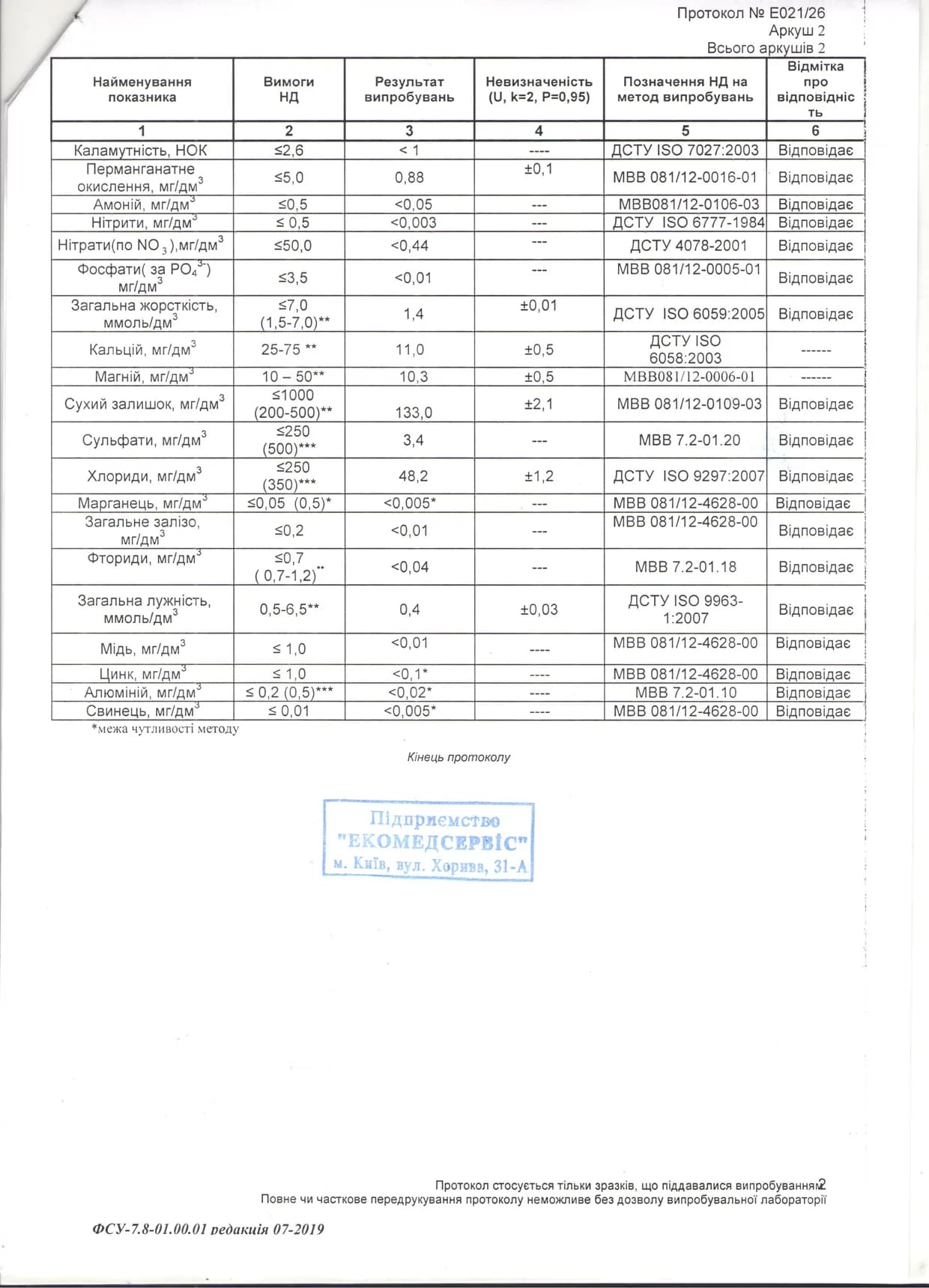
In August 2026 the accredited Ekomedservice Ecological Laboratory (DSTU EN ISO/IEC 17025, NAAU certificate No. 20678) tested all three of Arctica’s drinking-water lines. The samples were taken on 4 August 2026; test reports No. E019/26 (Ridna Voda), No. E020/26 (Ridna Kraplyna) and No. E021/26 (Arctica) were approved on 10 August 2026. The conclusion is the same in each: the water complies with the requirements of DSanPiN 2.2.4-171-10, the Ukrainian drinking-water standard, for physico-chemical parameters. In all three lines odour and taste score 0 points against a limit of 2, nitrates are below 0.44 mg/L against a limit of 50, lead below 0.005 against 0.01, iron below 0.01 against 0.2. The lines differ in their mineral composition: Ridna Voda is the softest (total hardness 0.16 mmol/L, dry residue 25.0 mg/L); Ridna Kraplyna carries magnesium (15.8 mg/L), Arctica both calcium and magnesium (11.0 and 10.3 mg/L); both have a hardness of 1.4 mmol/L and a dry residue of 123.0 and 133.0 mg/L respectively.
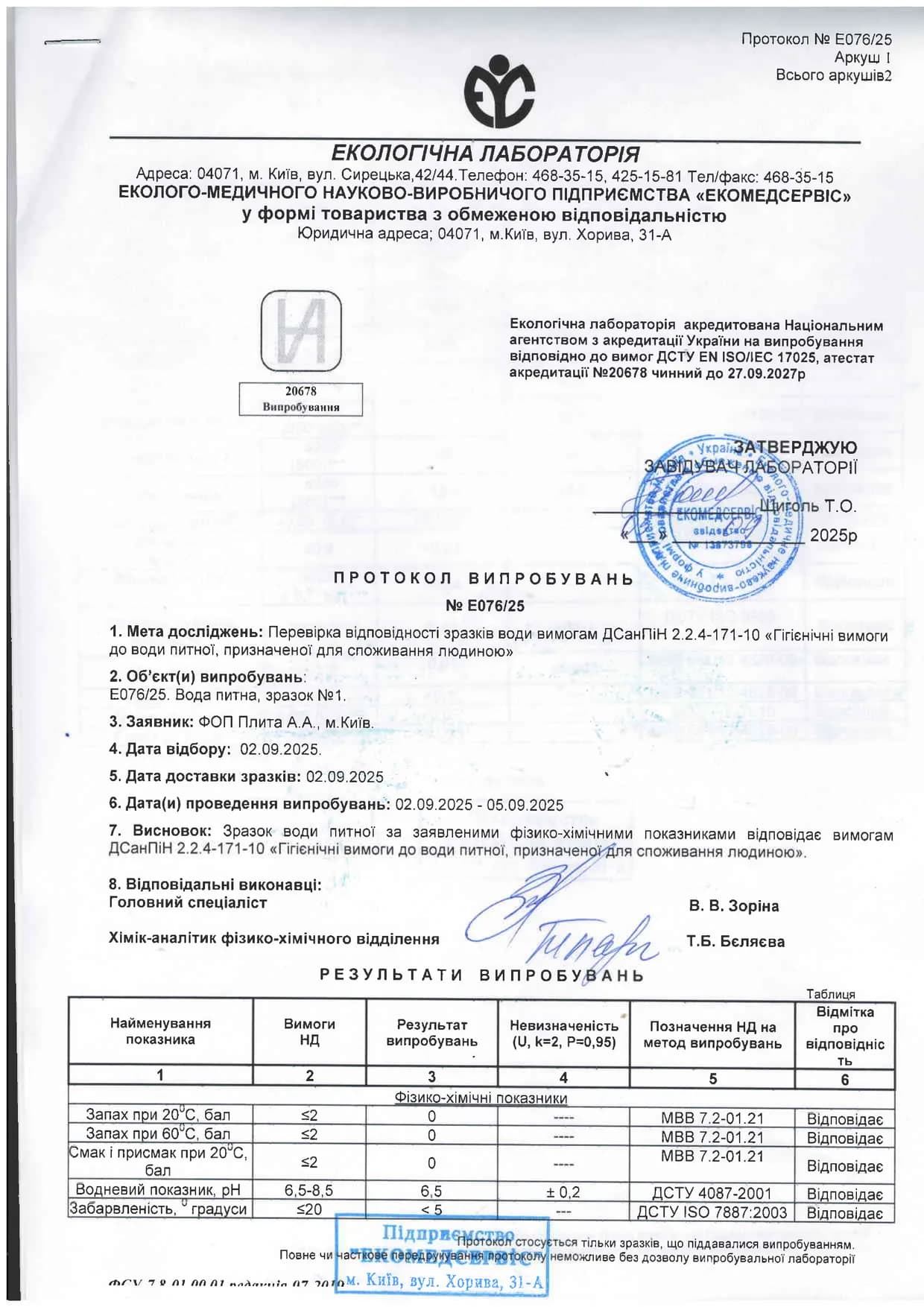
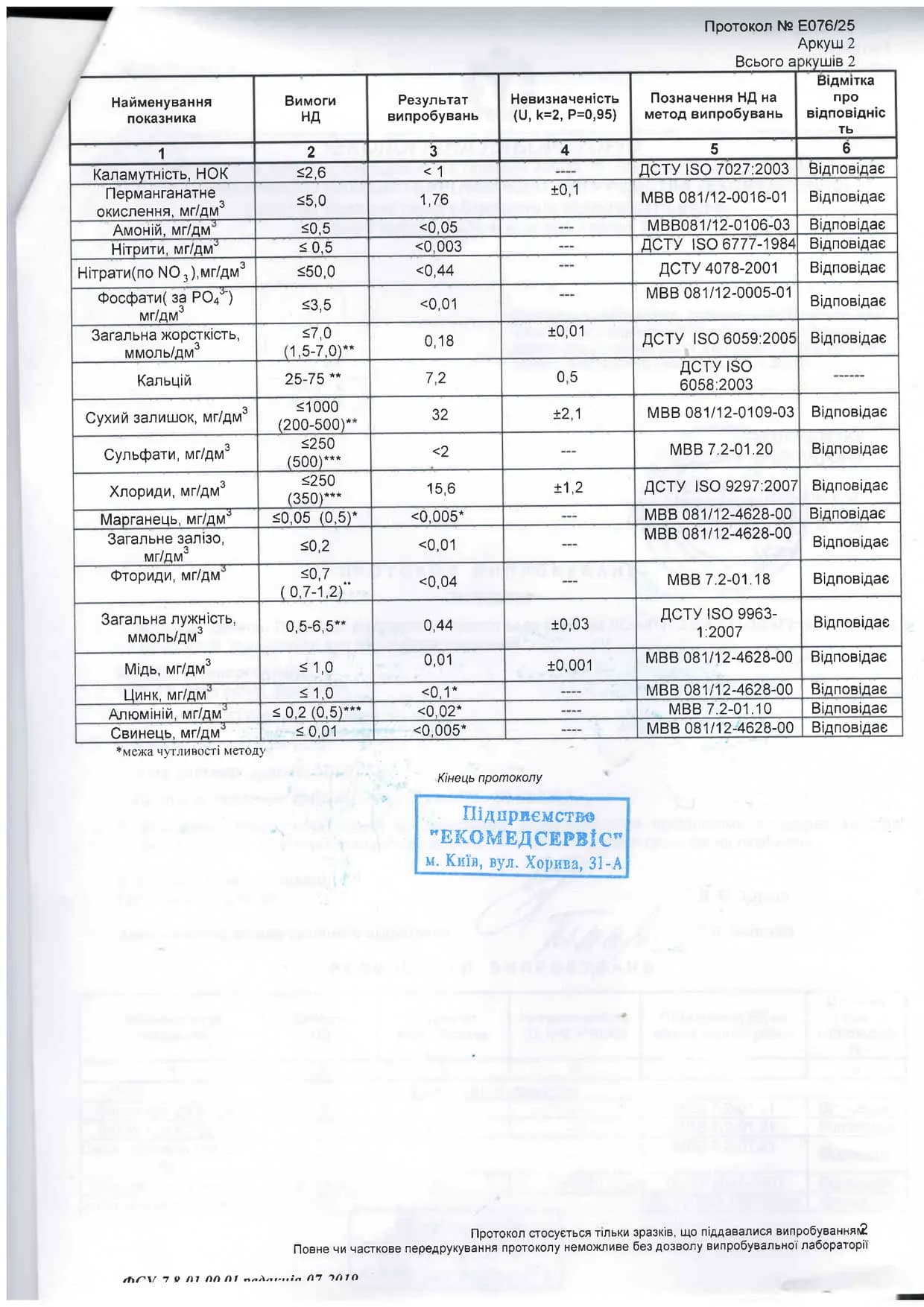
Below: every parameter of the three reports next to its limit, scans of all six sheets, and the previous report for Ridna Voda from September 2025 for comparison over time.
3 reportsone for each lineall three samples taken on the same day
0 pointsodour and taste in all threeagainst a limit of 2 points
<0.44nitrates, mg/L, in all threelimit 50.0 — more than 100 times lower
<0.005lead, mg/L, in all threelimit 0.01
Three lines
The same safety, a different mineral composition
On the safety parameters the three lines do not differ: lead, iron, manganese, nitrates and ammonium are below the detection limit of the method in all three, and permanganate oxidisability is 0.8–0.88 mg/L against a 5.0 limit. The difference lies only in the amount of dissolved salts — and that is exactly what is worth understanding when choosing a water.
Test report No. E019/26
Ridna Voda
The softest of the three
Reverse-osmosis water with almost no dissolved salts: a delicate, neutral taste, and practically no limescale in a kettle, coffee machine or cooler.
When to choose it: if the priority is no limescale in the kettle, coffee machine or cooler.
Every parameter of the three lines next to its limit
The samples were taken on the same day, 4 August 2026, and tested in the same laboratory by the same methods — so the columns can be compared directly. The table repeats the reports line by line, including the parameters where our water carries fewer salts than the recommended range.
Safety: metals, nitrates, organics
Safety: metals, nitrates, organics — test results for Ridna Voda, Ridna Kraplyna and Arctica water under reports Nos. E019/26, E020/26 and E021/26 compared with the limits of DSanPiN 2.2.4-171-10
Parameter
DSanPiN 2.2.4-171-10 limit / recommendation**
Ridna VodaNo. E019/26
Ridna KraplynaNo. E020/26
ArcticaNo. E021/26
Nitrates (as NO₃), mg/L
≤ 50.0
< 0.44
< 0.44
< 0.44
Nitrites, mg/L
≤ 0.5
< 0.003
< 0.003
< 0.003
Ammonium, mg/L
≤ 0.5
< 0.05
< 0.05
< 0.05
Lead, mg/L
≤ 0.01
< 0.005
< 0.005
< 0.005
Manganese, mg/L
≤ 0.05
< 0.005
< 0.005
< 0.005
Total iron, mg/L
≤ 0.2
< 0.01
< 0.01
< 0.01
Copper, mg/L
≤ 1.0
< 0.01
< 0.01
< 0.01
Zinc, mg/L
≤ 1.0
< 0.1
< 0.1
< 0.1
Aluminium, mg/L
≤ 0.2
< 0.02
< 0.02
< 0.02
Phosphates (as PO₄³⁻), mg/L
≤ 3.5
< 0.01
< 0.01
< 0.01
Permanganate oxidisability, mg/L
≤ 5.0
0.8
0.88
0.88
Fluorides, mg/Lrecommended range 0.7–1.2**
≤ 0.7
< 0.04
< 0.04
< 0.04
Organoleptics: how the water looks and tastes
Organoleptics: how the water looks and tastes — test results for Ridna Voda, Ridna Kraplyna and Arctica water under reports Nos. E019/26, E020/26 and E021/26 compared with the limits of DSanPiN 2.2.4-171-10
Parameter
DSanPiN 2.2.4-171-10 limit / recommendation**
Ridna VodaNo. E019/26
Ridna KraplynaNo. E020/26
ArcticaNo. E021/26
Odour at 20 °C, points
≤ 2
0
0
0
Odour at 60 °C, points
≤ 2
0
0
0
Taste and aftertaste at 20 °C, points
≤ 2
0
0
0
Colour, degrees
≤ 20
< 5
< 5
< 5
Turbidity, NTU
≤ 2.6
< 1
< 1
< 1
Dissolved salts and acidity
Dissolved salts and acidity — test results for Ridna Voda, Ridna Kraplyna and Arctica water under reports Nos. E019/26, E020/26 and E021/26 compared with the limits of DSanPiN 2.2.4-171-10
Parameter
DSanPiN 2.2.4-171-10 limit / recommendation**
Ridna VodaNo. E019/26
Ridna KraplynaNo. E020/26
ArcticaNo. E021/26
pH value
6.5–8.5
6.5
6.56
6.55
Dry residue (TDS), mg/Lrecommended range 200–500**
≤ 1000
25.0
123.0
133.0
Total hardness, mmol/Lrecommended range 1.5–7.0**
≤ 7.0
0.16
1.4
1.4
Total alkalinity, mmol/Lrecommended range**
0.5–6.5**
0.4
0.5
0.4
Calcium, mg/Lrecommended range**; a dash in the report — explained below
25–75**
3.6
2.0
11.0
Magnesium, mg/Lrecommended range**; a dash in the report; not tested for Ridna Voda
10–50**
—
15.8
10.3
Sulphates, mg/L
≤ 250
3.6
3.4
3.4
Chlorides, mg/L
≤ 250
11.4
46.8
48.2
‘<’ — the parameter is below the detection limit of the method: the laboratory records that there is less of the substance than the figure shown.
** — a recommended range for mineral composition from Appendix 4 of DSanPiN 2.2.4-171-10, not a hygiene limit; see ‘What these figures actually mean’ below.
‘—’ — the parameter was not tested in the report for that line.
The limits in the second column are those of the Ukrainian standard DSanPiN 2.2.4-171-10. The testing was not carried out against Directive (EU) 2020/2184, so we make no claim about European requirements — the measured values are published so that you can compare them with whichever standard you work to.
Nothing left unsaid
What these figures actually mean
Three things we state plainly, because they are exactly what a buyer should understand.
Mineral content
Appendix 4 of DSanPiN recommends 200–500 mg/L of dry residue and 1.5–7.0 mmol/L of hardness for drinking water. All three of our lines carry fewer salts than that, and we do not hide it. Ridna Voda is reverse-osmosis water with almost no dissolved salts: 25.0 mg/L of dry residue, hardness 0.16. Ridna Kraplyna and Arctica carry about five times more salts — 123.0 and 133.0 mg/L, hardness 1.4 — yet still less than the recommended range: only slightly for hardness, noticeably for dry residue. This is not a breach of the standard: compliance is assessed against Appendices 1–3, and on those all three reports conclude ‘complies’. The practical consequence is a neutral taste and little limescale. The same applies to total alkalinity: 0.4 mmol/L in Ridna Voda and Arctica against a recommended 0.5–6.5 — again Appendix 4, again a recommendation, not a limit. And the pH of Ridna Voda, 6.5, sits exactly on the lower bound of the 6.5–8.5 range: within the limit, with no margin, and we say so.
Why calcium and magnesium carry a dash
In the scans, the ‘compliance’ column for calcium and magnesium holds a dash. That does not mean ‘fails’: for these parameters there is no hygiene limit at all — only the recommended range of Appendix 4 (calcium 25–75, magnesium 10–50 mg/L). The laboratory measured the values — calcium 3.6, 2.0 and 11.0 mg/L for Ridna Voda, Ridna Kraplyna and Arctica, magnesium 15.8 and 10.3 for the latter two — but there is no mandatory figure to compare them with, so it put a dash in the cell. Magnesium was not tested for Ridna Voda: there is no such row in its report.
What exactly these reports confirm
These are physico-chemical test reports: 24 parameters for Ridna Voda and 25 each for Ridna Kraplyna and Arctica. So we write exactly what the laboratory wrote: compliance with DSanPiN 2.2.4-171-10 for physico-chemical parameters — and we do not read more into the documents than they contain.
The original documents
Test reports Nos. E019/26, E020/26 and E021/26
Ekomedservice Ecological Laboratory, 42/44 Syretska St., Kyiv. Accreditation: DSTU EN ISO/IEC 17025, NAAU certificate No. 20678, valid until 27 September 2027. Samples taken 4 August 2026, testing carried out 4–10 August 2026, approved 10 August 2026. Each report is published in full, both sheets, unedited. The documents are issued in Ukrainian; the table above gives every figure in English.
Ridna Voda — test report No. E019/26
Sample No. 1 · taken 4 August 2026 · tested 4–10 August 2026 · 24 parameters
National Accreditation Agency of Ukraine, DSTU EN ISO/IEC 17025, NAAU certificate No. 20678, valid until 27 September 2027
Samples taken
4 August 2026 — all three on the same day
Testing carried out
4–10 August 2026
Reports approved
10 August 2026
Standard applied
DSanPiN 2.2.4-171-10 — the Ukrainian hygiene standard for drinking water intended for human consumption
Scope
Physico-chemical parameters: 24 for Ridna Voda, 25 each for Ridna Kraplyna and Arctica.
Archive
Previous report: Ridna Voda, No. E076/25
Sample taken 2 September 2025, testing carried out 2–5 September 2025, the same laboratory. We keep it on the page to show how the composition of the water holds over time: within a year the safety parameters did not change, and the 2026 sample carries even fewer salts.
Comparison of Ridna Voda water under reports No. E076/25 (September 2025) and No. E019/26 (August 2026)
Parameter
Sep 2025No. E076/25
Aug 2026No. E019/26
Total hardness, mmol/L
0.18
0.16
Dry residue, mg/L
32
25.0
Permanganate oxidisability, mg/L
1.76
0.8
Chlorides, mg/L
15.6
11.4
Nitrates, mg/L
< 0.44
< 0.44
Lead, mg/L
< 0.005
< 0.005
E076/25, sheet 1E076/25, sheet 2
Questions about quality
The short answers
Does Arctica's water comply with the Ukrainian drinking-water standard?
Yes — all three lines. Under test reports Nos. E019/26, E020/26 and E021/26 from the accredited Ekomedservice laboratory, the samples of Ridna Voda, Ridna Kraplyna and Arctica water comply with the requirements of DSanPiN 2.2.4-171-10, the Ukrainian hygiene standard for drinking water, for the physico-chemical parameters tested. Not one of the parameters tested exceeds a hygiene limit of the standard.
Is there a separate report for each line?
Yes. The laboratory took three separate samples on the same day, 4 August 2026: sample No. 1 — Ridna Voda (report No. E019/26), sample No. 2 — Ridna Kraplyna (No. E020/26), sample No. 3 — Arctica (No. E021/26). We never carry the figures of one line over to another: each column in the table on this page comes from its own document.
Which standard was the water tested against — Ukrainian or European?
The Ukrainian one: DSanPiN 2.2.4-171-10. The testing was not carried out against Directive (EU) 2020/2184, so we make no claim about European requirements. What the reports do show is the measured value of every parameter next to its Ukrainian limit, so you can compare the figures with any standard you use.
How do the three lines differ in composition?
In safety — not at all: nitrates, lead, iron, manganese and ammonium are below the detection limit of the method in all three. The difference is in the mineral content. Ridna Voda: dry residue 25.0 mg/L, total hardness 0.16 mmol/L — the softest. Ridna Kraplyna: dry residue 123.0 mg/L, hardness 1.4 mmol/L, magnesium 15.8 mg/L against 2.0 of calcium. Arctica: dry residue 133.0 mg/L, hardness 1.4 mmol/L, calcium 11.0 and magnesium 10.3 mg/L.
Which water should I choose for a coffee machine or a kettle?
If the priority is no limescale, take Ridna Voda: total hardness 0.16 mmol/L against a limit of 7.0 — more than 40 times lower, which means there are almost no hardness salts in it. In Ridna Kraplyna and Arctica the hardness is 1.4 mmol/L — still five times below the limit, so there will be little limescale, but some is possible.
What does DSanPiN say about the mineral content of our water?
Appendix 4 of DSanPiN 2.2.4-171-10 recommends 200–500 mg/L of dry residue and 1.5–7.0 mmol/L of hardness for the mineral composition of drinking water. It is a recommendation, not a hygiene limit: compliance is assessed against Appendices 1–3, and on those all three reports conclude ‘complies’. Ridna Voda is reverse-osmosis water with almost no dissolved salts; Ridna Kraplyna and Arctica carry noticeably more (123.0 and 133.0 mg/L), yet still less than the recommended range: only slightly for hardness (1.4 against 1.5), noticeably for dry residue (against 200). We state this plainly rather than hide it.
Who carried out the testing?
Ekomedservice Ecological Laboratory, 42/44 Syretska St., Kyiv. The laboratory is accredited by the National Accreditation Agency of Ukraine to DSTU EN ISO/IEC 17025, NAAU certificate No. 20678, valid until 27 September 2027. All three reports were approved by the head of the laboratory on 10 August 2026.
When were the samples taken?
All three samples were taken and delivered to the laboratory on 4 August 2026; the testing ran from 4 to 10 August 2026 and the reports were approved on 10 August 2026.
Is the composition of the water stable over time?
For Ridna Voda there is a previous report, No. E076/25, from September 2025 — it is published on this page in the Archive section. Within a year the safety parameters did not change (nitrates below 0.44, lead below 0.005), and the 2026 sample carries even fewer salts: hardness 0.18 → 0.16 mmol/L, dry residue 32 → 25.0 mg/L.
The scans are in Ukrainian — can I get the figures in English?
The documents themselves are issued in Ukrainian, as any Ukrainian laboratory report is. The table on this page reproduces them line by line in English, parameter by parameter, so you can read every result without translating the scans. If your organisation needs the originals for its files, all six sheets are published in full on this page.
Order in English
Questions about the reports? Ask us in English
Embassies, international offices and expat households usually need the documents themselves. Write to us in Telegram or Viber — an English-speaking operator will answer questions about the reports and arrange your delivery.